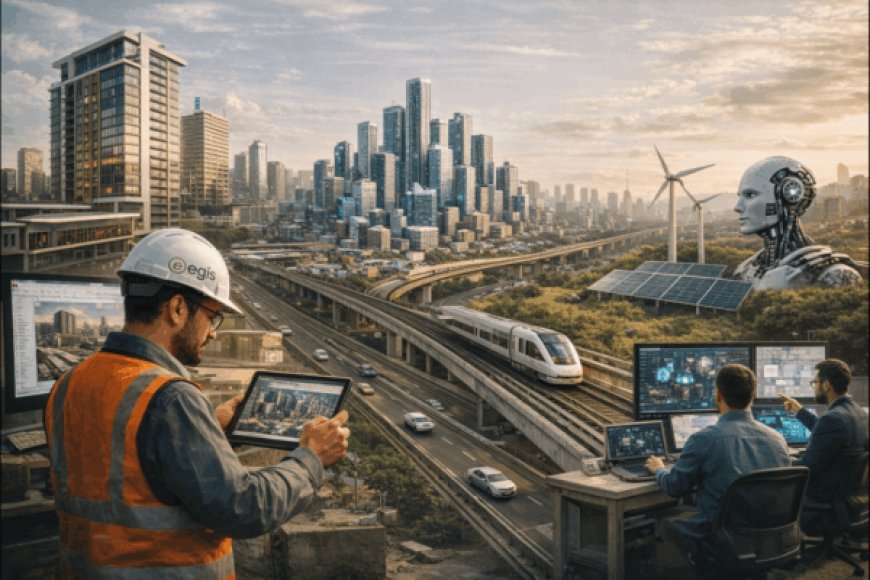
The Telangana government is preparing to design a 3D Digital Twin City modeled on Hyderabad, a move expected to set a new benchmark in India’s real estate and infrastructure sectors. Experts believe digital twin technology will not only transform building construction but also completely redefine building operations and maintenance.
A digital twin is a virtual, computer-generated replica of a physical asset. Using IoT sensors installed on lifts, air-conditioning systems, electrical networks, and water supply pipelines, real-time data is continuously fed into the digital model. This enables authorities to monitor the live condition of a building or city on a computer or mobile screen.
Unlike traditional maintenance—where repairs are carried out only after equipment fails—digital twin technology enables predictive maintenance, allowing issues to be detected well in advance. For instance, if abnormal vibration begins in an elevator motor, sensors immediately alert the digital twin system, enabling technicians to intervene before the problem escalates. This reduces major repair costs, prevents accidents, and allows faster responses during emergencies such as fires, floods, or natural disasters.
Experts estimate that digital twin adoption can reduce building maintenance costs by 25–30%. The technology precisely identifies electricity wastage, water leakages, and inefficiencies, helping reduce carbon footprints and enabling eco-friendly maintenance. It is particularly beneficial for large-scale infrastructure such as multi-storey apartments, IT parks, and airports.
To implement the project, Hyderabad Metropolitan Development Authority (HMDA) is preparing to issue an Expression of Interest (EOI) to select a technology partner. Plans are already in place to develop the 3D digital twin across 2,053 sq km, up to the Outer Ring Road limits. The area will be mapped using drones and 3D scanners, while data from revenue, water supply, electricity, and other departments will be integrated to create a comprehensive digital city model.
The platform will also generate simulated visual scenarios to address challenges such as traffic congestion, flood risks, and emergency response planning.
The Central Government is actively encouraging the use of digital twin technology in infrastructure planning. Cities such as Kohima, Kanpur, Mumbai, and Kochi have already begun using it. Hyderabad is now set to join this list. Experts estimate that by 2026, nearly 20% of major real estate projects in India will adopt digital twin technology, making it a key driver not just for smart buildings, but for smart cities as well.