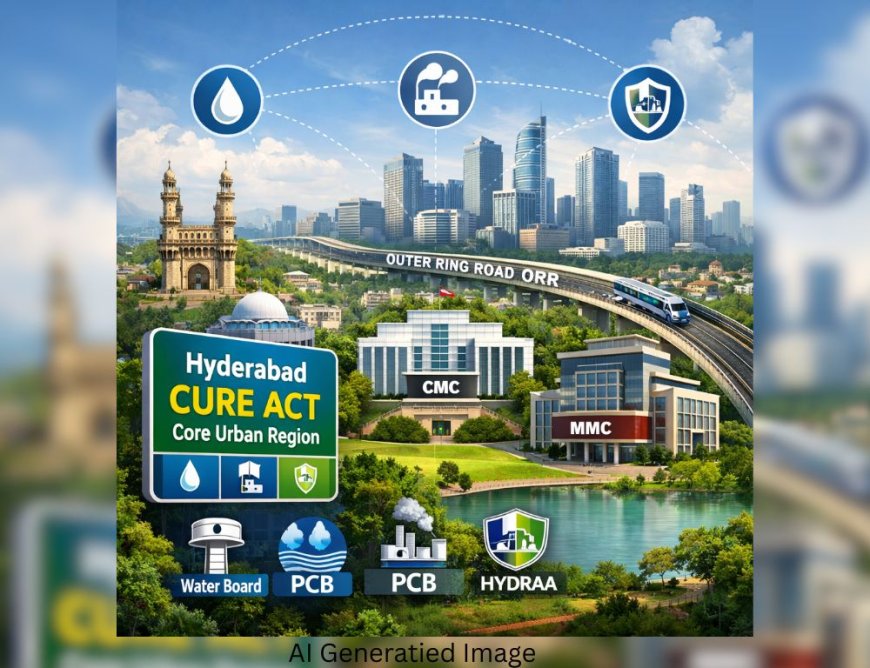
A new chapter has begun in the development of Hyderabad. Replacing the GHMC Act that had been in force for nearly seven decades, the Core Urban Region (Integrated Governance) Act, 2026 has now come into effect.
With the Gazette notification issued on October 2, a new urban governance framework is now in place for the CORE region.
The Act brings the three municipal corporations — Greater Hyderabad, Cyberabad, and Malkajgiri — under a coordinated system. It also enables metropolitan-level coordination of roads, drainage, water supply, traffic, disaster management and protection of public assets.
However, the change is particularly important for the real estate sector. From land purchases and apartment construction to commercial projects and property tax, the new governance system could influence several aspects of Hyderabad’s property market.
Where will the real estate impact be felt?
As Hyderabad’s expansion rapidly moves towards the Outer Ring Road, the government has introduced the CORE system to plan infrastructure across the wider metropolitan region under a unified approach.
The government has previously described CORE as an important economic region for Hyderabad’s metropolitan growth. With rising population and construction density, the government has highlighted the need to manage water supply, drainage, roads, solid waste, and other civic infrastructure at a regional level rather than separately.
For real estate experts, the implication is clear: going forward, land value may not be determined by location alone. The quality of infrastructure, flood risk, road connectivity, drainage, and compliance with building regulations could also become increasingly important.
Also Read: Hyderabad Property Tax: New Rules Under CURE Bill
One disaster management plan
The Act gives importance to a coordinated disaster management system across the CORE region.
HYDRAA is already functioning in the CORE area as an agency responsible for disaster management, rescue operations, floods, fallen trees and other emergency situations.
According to official HYDRAA information, its disaster management wing monitors disaster preparedness, emergency response, rescue and relief operations, along with weather, rainfall and flood warnings.
Why is this important for real estate?
Experts believe scrutiny of projects located near flood-prone areas, lakes, nalas and natural drainage channels could increase in the future.
Until now, buyers often focused on whether a project had the required local approvals. Going forward, questions such as these could become part of property risk assessment:
- Is the area prone to flooding?
- What is the drainage capacity?
- Is there a lake or nala nearby?
- Can emergency vehicles access the property?
- Does the project meet fire safety standards?
- Has the building been constructed according to the approved plan?
- Fire safety could become a bigger issue
The possibility of making fire audit certificates mandatory for buildings above a specified height could be another important development for the real estate sector.
Fire safety compliance is particularly relevant for high-rise apartments, commercial complexes, office spaces, hospitality projects and warehouses.
Fire safety, occupancy certificates and approved building plans are already important requirements in the construction sector. If inspections and coordination between departments increase under the new system, projects that do not comply with regulations could face greater legal and financial risks.
For new homebuyers, this means that price and location alone may no longer be enough. Building compliance could become an equally important factor when evaluating a property.
Also Read: Repo rate hike: Realty expects housing demand to stay strong
Infrastructure quality vs location
Hyderabad’s property market has traditionally been influenced by the ORR, Metro connectivity, IT corridors, airport connectivity and the Future City.
Under the CORE governance system, if coordination improves around roads, drainage, water supply, sewerage, traffic and public transport at the regional level, investors may increasingly prefer areas with stronger infrastructure.
At the same time, buyers may need to be more cautious about investing in areas where infrastructure remains weak simply because land prices are lower.
In other words, the question may no longer be just, “How much does an acre cost?” It could increasingly become, “What kind of infrastructure will this acre have in the future?”
Automatic mutation, a relief for property buyers
The new CORE system also aims to simplify property-related services.
The government plans to introduce a system under which the mutation process can be automatically initiated after property registration.
If implemented, this could reduce the need for property buyers to visit municipal offices repeatedly.
This is not a minor change for the real estate sector. Coordination between title, registration, mutation and property tax records is critical to property transactions.
A new compliance era for developers?
Under the CORE system, committees are expected to coordinate among the three municipal corporations, police, revenue, HMDA, the Water Board, power utilities, Metro, RTC and HYDRAA.
This could improve coordination in resolving issues involving multiple departments for a single project.
At the same time, compliance responsibilities for developers could increase. Issues such as obtaining approvals for one plan but constructing differently, changes to parking arrangements, obstruction of fire access routes and unauthorised construction could potentially receive greater scrutiny in the future.
Also Read: Rate hike puts festive housing demand on watch: Anuj Puri
CCTV could bring another change to commercial property
The Act gives importance to CCTV surveillance in markets, transport hubs and other public places. This could make safety infrastructure an increasingly important part of urban planning.
The change could be particularly relevant for malls, markets, commercial streets and transport hubs. If connectivity is already an important factor in real estate value, safety, accessibility and infrastructure could increasingly become part of the valuation of commercial properties as well.
The new system could gradually change how developers, investors and homebuyers evaluate property in Hyderabad.