• High-rise definition revised: 21 metres and above
• 18–21m buildings allowed on 750–2000 sq. m (897- 2,392 sq. yards) plots via TDR
• Setback relaxations permitted using TDR
• High-rises get up to 10% setback relaxation (min 7m mandatory)
• Option to pay charges or use TDR if master plan roads change
• Extra floors allowed (up to 5) based on road width
• Phased TDR payment: 50% at approval, 50% before occupancy
• New TDR loading rules for buildings above 10 & 20 floors
(King Johnson Koyyada, 9030034591)
The Telangana Government has issued fresh amendments to the Telangana Building Rules, 2012, introducing significant relaxations and enhanced flexibility in the utilization of Transferable Development Rights (TDR), in a move aimed at streamlining urban development and boosting the real estate sector. Through G.O. Ms. No. 95 dated March 21, 2026, the Metropolitan Area & Urban Development (MA&UD) Department announced key changes following representations from stakeholders seeking rationalization of TDR provisions and easing of building regulations.
As per the amendments, buildings with a height of 21 metres or more will now be classified as high-rise structures, with certain utility structures excluded from this definition. The government has permitted buildings between 18 to 21 metres in height on plots ranging from 750 sq. m to 2,000 sq. m (897- 2,392 sq. yards) provided TDR is utilised and parking norms are met.
In a major relief to developers, setback relaxations have been allowed through TDR. Non-high-rise buildings can avail such relaxations while maintaining minimum setbacks in road widening cases, whereas high-rise buildings can get up to 10% relaxation, subject to a minimum 7-metre setback.
The amendments also offer flexibility in cases where master plan roads are modified or removed, allowing developers to either pay applicable charges or submit equivalent TDR. Further, additional floors have been permitted for larger plots above 2,000 sq. m based on road width—up to three extra floors for 40-ft roads, four for 60-ft roads, and five for 80-ft roads—subject to TDR utilisation and compliance with fire and aviation norms.
Revised provisions also mandate phased TDR submission, with 50% required at the building permission stage and the remaining before occupancy certification. The government stated that these reforms aim to promote planned urban growth while providing greater operational flexibility to developers.
How This Benefits Telangana Construction Industry?
These amendments are a major positive push for the construction and real estate sector in Telangana. Firstly, increased flexibility in building norms allows developers to optimize land use better. With permissions for additional floors linked to road width, projects can now achieve higher saleable area, improving project viability and profitability.
Secondly, setback relaxations through TDR reduce design constraints, especially in urban areas where land parcels are irregular or limited. This enables more efficient project planning without compromising regulatory compliance.
The policy also strengthens the TDR ecosystem, creating a more active market for development rights. Landowners affected by road expansions, buffer zones, or restrictions can monetize their land through TDR, while developers gain additional buildable potential—creating a win-win situation. Further, phased TDR submission eases financial pressure on builders, improving cash flow management during project execution.
Overall, these reforms are expected to accelerate urban development projects, significantly improve housing supply—particularly in high-demand areas—attract increased investment into the real estate sector, and promote more structured, well-planned city growth within established regulatory frameworks. In essence, the new rules strike a balance between regulation and growth, making Telangana’s real estate environment more developer-friendly while supporting structured urban expansion.
Thanks to CM Revanth Reddy..
I extend my sincere thanks to Chief Minister Revanth Reddy for taking a progressive and transformative decision to support small and medium-scale builders in Telangana. The incentives provided in the form of Transferable Development Rights (TDR) will help in regulating and stabilizing apartment prices. Previously, on a 40-feet road, there was a provision to construct up to eight floors along with an additional two floors through TDR. This has now been increased, allowing construction of up to eleven floors.
Similarly, on a 60-feet road, the earlier limit of 12+2 floors has now been enhanced to 12+4 floors. In the case of 80-feet roads, the permissible construction has been increased from 15+2 floors to 15+5 floors. This decision by the government will benefit not only TDR holders but also small-scale builders. With the allowance for additional floors, builders gain greater flexibility, and in turn, homebuyers are likely to benefit from more reasonably priced apartments. — Gummi Ram Reddy, President (Elect), CREDAI National
A Game-Changer for TDR Demand and Urban Growth
In my view, GO Ms. No. 95 is a forward-looking and impactful policy that brings multiple advantages to the real estate ecosystem. With this reform, the demand for Transferable Development Rights (TDR) is expected to rise significantly, creating better value for stakeholders. Small landowners stand to benefit through access to additional built-up area, while high-rise developers will gain from the reduced TDR requirements, improving project feasibility.
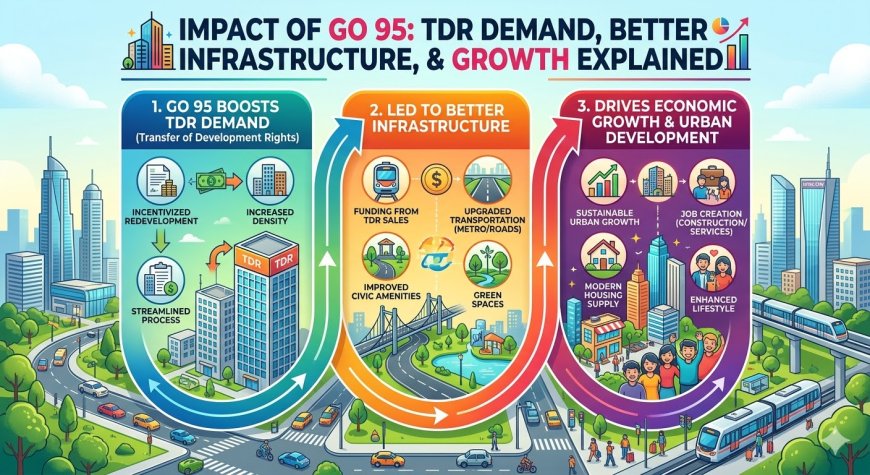
Importantly, this policy also serves the larger public interest. As TDR gains stronger market demand, landowners are more likely to come forward to contribute land for road expansion and infrastructure development, which will ultimately lead to better urban infrastructure. Additionally, extending TDR benefits to lands within lake buffer zones is a noteworthy step, as it can support lake rejuvenation efforts and contribute to an improved quality of life across the city.- Prashant Rao, Director- Poulomi Estates